Bedtime should be the simplest part of the day. Your kid is tired, you are tired, the bed is right there. But if you are a parent, you know that bedtime can easily become the most stressful 45 minutes of your entire evening. The stalling, the requests for water, the sudden need to tell you about something that happened at school six hours ago, the “I’m not tired” from a child who was rubbing their eyes five minutes ago.
The good news is that a consistent, well-structured bedtime routine can change all of this. Not overnight (pun intended), but within a few days of commitment, most families see a real difference. The research backs this up. Studies show that children who follow a bedtime routine go to sleep earlier, fall asleep faster, sleep longer, and wake up less during the night. Those benefits have been observed years later in children who developed the routine when they were young.
This post is not a list of 25 tips you will never remember. It is a straightforward, step-by-step routine that you can start tonight, adjust to your family, and actually stick with.
Disclaimer: Every child is different, and what works for one family may need adjusting for another. Ages, temperaments, schedules, and family dynamics all play a role. Use this as a framework and adapt it to fit your situation.
Why Bedtime Routines Work (The Short Version)
Kids thrive on predictability. When they know what is coming next, they feel safe. When they feel safe, they relax. When they relax, they sleep.
A bedtime routine works because it gives your child’s brain a series of signals that say “the day is ending and sleep is coming.” Each step in the routine is like a cue. Bath means we are winding down. Pajamas mean we are getting close. Story means sleep is almost here. After enough repetition, your child’s body starts to respond to these cues automatically. Their heart rate slows, their muscles relax, and melatonin (the natural sleep hormone) starts doing its job.
Without a routine, bedtime feels abrupt. One minute they are playing, the next minute you are telling them to get in bed. Their brain has not had time to transition, which is why they resist. The routine is the transition.
The Routine: Step by Step
This routine is designed to take 30 to 45 minutes from start to lights out. It works for kids roughly ages 2 through 10, with modifications for different ages noted along the way.
Step 1: Give the Warning (30 to 45 Minutes Before Bed)
Do not spring bedtime on your child. Give them a heads-up so they can mentally prepare. Something as simple as “Hey, bedtime is in 30 minutes” gives them time to wrap up whatever they are doing.
For younger kids who do not have a strong sense of time, make it concrete. “After this show ends, we start getting ready for bed” or “You can play with that for five more minutes, then it is bath time.”
This one step alone can eliminate a significant amount of bedtime resistance. The warning removes the element of surprise, which is often what triggers the pushback.
Step 2: Screen Off (At Least 30 Minutes Before Bed)
This is non-negotiable, and it is one of the hardest habits to establish, but also one of the most impactful. Screens emit blue light that suppresses melatonin production, which is the hormone that tells your child’s body it is time to sleep. Research shows that the vast majority of children look at a screen shortly before bed, and it makes falling asleep significantly harder.
Turn off the TV, put away the tablet, and set phones aside. This applies to the whole family, not just the kids. If they see you scrolling while telling them screens are done, the message does not land.
Replace screen time with a calm, low-stimulation activity. This is a natural transition point into the next step.
Step 3: Bath or Wash Up
A warm bath is one of the most effective sleep signals you can give a child. It is not just about hygiene. The warm water raises body temperature slightly, and when they get out, the body cools down, which naturally triggers drowsiness. It is a biological hack that works remarkably well.
A bath does not need to happen every single night. On nights when a full bath is not practical, washing hands and face, or a quick warm washcloth wipe-down, still serves as a physical transition marker. The act of “cleaning up” signals the end of the day.
For older kids who shower independently, the routine still works. A warm shower followed by putting on pajamas serves the same purpose.
Step 4: Pajamas and Teeth
Keep this step straightforward and consistent. Same order every night. Pajamas first, then brush teeth. Or teeth first, then pajamas. The order matters less than the consistency. Your child’s brain learns the sequence and starts to associate it with winding down.
For younger children, this is also a great opportunity to build independence. Let them pick their own pajamas (from two or three options to avoid a 15-minute wardrobe deliberation). Let them brush their own teeth first, then you do a quick follow-up brush. These small choices give them a sense of control, which reduces resistance.
Step 5: Calm Activity (10 to 15 Minutes)
This is the most important step in the entire routine, and it is the one most families either skip or rush through. After pajamas and teeth, your child needs a quiet activity that brings their energy down one more level before getting into bed.
The best options for this window are:
Reading together. This is the gold standard. Reading before bed builds vocabulary, strengthens your bond, and naturally slows everything down. For younger kids, you read to them. For older kids, they can read independently or you can take turns reading aloud. Two to three short books for toddlers, or one chapter of a longer book for older kids, is a good target.
Coloring or drawing. Some kids wind down better with their hands busy. A few minutes of quiet coloring at a table or in bed can be an excellent bridge between active time and sleep. This is especially effective for kids who have trouble sitting still for a story.
We have found that keeping a coloring book on the nightstand works well for our kids on nights when they are too restless for a story. The Coloring Adventure Coloring Books by Remington Grey have been great for this because the pages are engaging enough to hold attention but calm enough that they do not ramp up energy. Ten minutes of coloring followed by lights out has become one of our most reliable wind-down strategies.
Listening to calm music or an audiobook. For kids who resist both reading and coloring at bedtime, soft background music or a short audiobook can fill this wind-down space. There are playlists and apps designed specifically for children’s bedtime, but even just quiet instrumental music works.
Quiet conversation. Sometimes the best wind-down activity is simply talking. Ask your child about the best part of their day, what they are looking forward to tomorrow, or something that made them laugh. Keep the conversation light and positive. Avoid topics that might cause worry or excitement right before sleep.
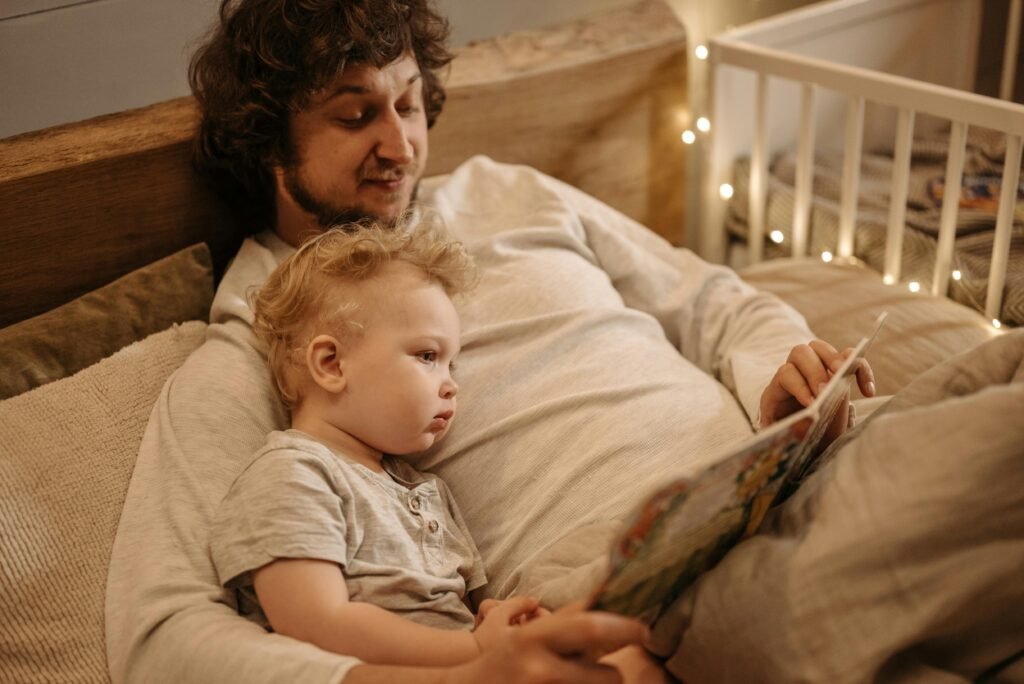
Step 6: Into Bed, Final Connection
Once the calm activity is done, it is time for bed. This is where you do your final goodnight ritual. Every family’s version is different, and that is fine. What matters is that it is consistent and brief.
Some options that work well:
- A hug and a kiss
- A specific phrase you say every night (“Goodnight, sleep tight, I love you”)
- A quick prayer or moment of gratitude
- One final affirmation (“I am proud of you today”)
If you have more than one child, consider alternating which parent puts each kid to bed on a given night. This is something my wife and I do, and it has made a noticeable difference. On Monday, I put our oldest to bed while she handles our youngest. On Tuesday, we swap. The routine stays the same for each child, but the parent delivering it rotates.
This does a few important things. First, it gives each child dedicated one-on-one time with each parent, which strengthens both bonds equally. Second, it prevents the situation where one child will only fall asleep for Mom or only for Dad, which becomes a real problem when one parent is unavailable. Third, it keeps both parents involved in bedtime rather than one person carrying that responsibility every night, which matters for your own energy and sanity.
The key is that the steps of the routine stay consistent regardless of which parent is on duty. Same order, same expectations, same calm tone. Kids adjust quickly to the rotation as long as the structure does not change.
This final connection point is more important than most parents realize. It is the last thing your child hears before they close their eyes, and it sets the emotional tone for how they fall asleep. A child who hears something positive and reassuring will drift off feeling safe. Make it count.
Step 7: Lights Out, Door Position, and Exit
Turn off the main light. If your child uses a nightlight, make sure it is a warm, dim color (red or orange are best because they do not interfere with melatonin the way blue or white light does).
Establish a clear expectation about the door. “I am going to leave the door open a crack” or “I will leave it open halfway.” Whatever you decide, keep it the same every night. Door position might seem like a small detail, but for many kids, it is a significant source of anxiety or negotiation. Setting it once and keeping it consistent removes it as a bargaining chip.
Then leave. Resist the urge to linger. A long, drawn-out departure invites more requests and delays. A confident, calm exit tells your child that you trust them to fall asleep, which helps them trust themselves.
Sample Routine by Age
Toddlers (Ages 2 to 3) – Start 30 to 40 minutes before bed: Warning → Screens off → Bath → Pajamas and teeth → Two to three short books in bed → Goodnight phrase and kiss → Lights out
Preschoolers (Ages 3 to 5) – Start 30 to 45 minutes before bed: Warning → Screens off → Bath or wash up → Pajamas and teeth → Story or quiet coloring → Conversation about the day → Goodnight phrase → Lights out
School Age (Ages 6 to 10) – Start 45 minutes to 1 hour before bed: Warning → Screens off → Shower or wash up → Pajamas and teeth → Reading (independent or together) or quiet activity → Brief conversation → Goodnight phrase → Lights out
How Much Sleep Does Your Child Actually Need?
This is worth knowing because it determines what time your routine should start. The American Academy of Sleep Medicine recommends:
- Ages 1 to 2: 11 to 14 hours (including naps)
- Ages 3 to 5: 10 to 13 hours (including naps)
- Ages 6 to 12: 9 to 12 hours
- Ages 13 to 18: 8 to 10 hours
If your child needs to wake up at 6:30 AM for school and they are 5 years old, they need roughly 11 hours of sleep. That means they should be asleep by 7:30 PM, which means your routine should start around 6:45 to 7:00 PM. Work backward from the wake-up time and you will find the right starting point for your family.
Common Problems and How to Handle Them
“I need water / I have to go to the bathroom / one more story.”
These are classic stall tactics, and every parent knows them. The best way to handle them is to build the answers into the routine. Include a small cup of water and a bathroom trip as standard steps before the final goodnight. When the requests come after lights out, you can calmly say “We already did that, remember? It is time to sleep now.” Consistency is the key. If you give in sometimes, they will try every time.
“I’m scared.”
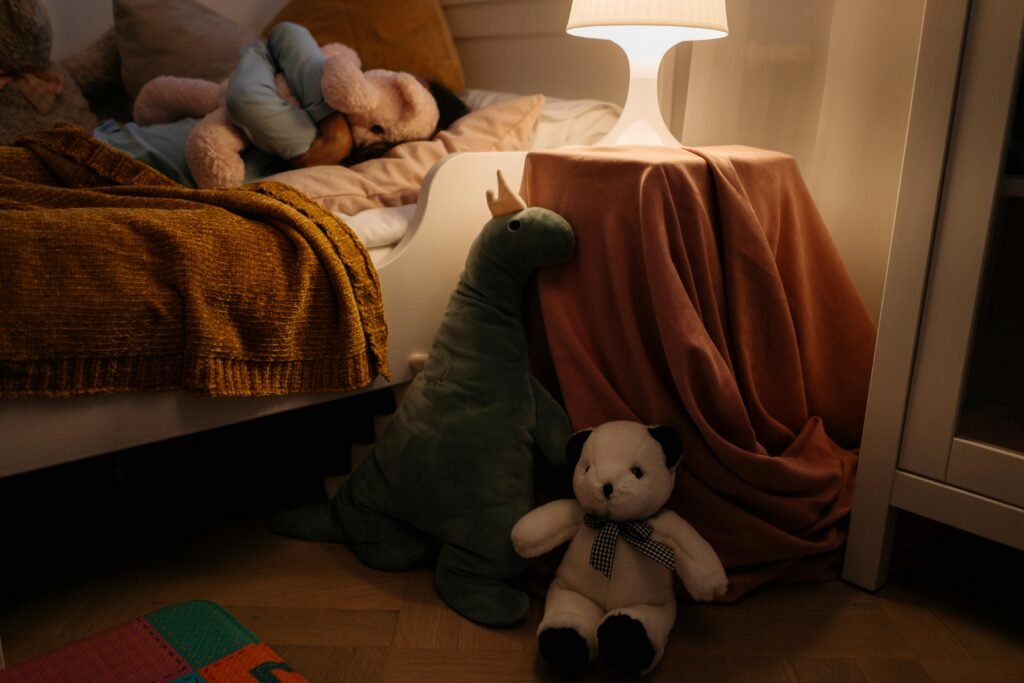
This is real for many kids, and it should not be dismissed. Acknowledge the feeling. “I understand you feel scared sometimes. Your room is safe, and I am right down the hall.” A nightlight, a favorite stuffed animal, or a quick “safety check” (looking under the bed or in the closet together) can help. Avoid making the safety check elaborate, or it becomes its own ritual that reinforces the fear.
“I’m not tired.”
They probably are, and their body just has not caught up yet. This is usually a sign that the wind-down portion of the routine needs more time or the screens-off rule is not being enforced early enough. If a child genuinely cannot fall asleep after 20 minutes, it is okay to let them do a quiet activity in bed (like looking at a book) until drowsiness kicks in. The rule is they stay in bed, in their room, with the lights low.
The routine works on weekdays but falls apart on weekends.
Try to keep bedtime within 30 minutes of the weekday time, even on weekends. Letting kids stay up an hour or two later on Friday and Saturday shifts their internal clock, making Monday night feel like jet lag. A little flexibility is fine, but a two-hour swing undoes a lot of the routine’s benefit.
Final Thoughts
A bedtime routine is not about being rigid or controlling. It is about creating a predictable, calm end to the day that helps your child feel safe enough to let go and fall asleep. The steps themselves are simple. The power is in the consistency.
You do not need to implement all of this perfectly on night one. Start with the pieces that feel most manageable. Maybe tonight that is just the warning and the screens-off rule. Tomorrow you add the calm activity. By the end of the week, you have a full routine in place.
The effort you put into bedtime tonight pays off in better mornings, better behavior, and better rest for the whole family. Including you.
A good bedtime routine is not just for your kids. It is for your sanity too.