If you have ever spent 30 minutes setting up a craft project only to have your child lose interest after five minutes, you are not alone. A lot of craft ideas out there look great on Pinterest but require constant parent involvement, specialized supplies, or a cleanup effort that takes longer than the activity itself.
The reality is, kids do not need elaborate projects to be creative. They need accessible materials, a clear starting point, and the freedom to do it themselves. The best arts and crafts for kids are the ones they can set up, work on, and feel proud of without you hovering over them the entire time.
This post is specifically about independent crafts. These are activities your child can do on their own (or mostly on their own) once you hand them the supplies. That means you get a few minutes of breathing room while your child is building real skills like creativity, fine motor coordination, problem-solving, and confidence.
Disclaimer: Every child’s ability to work independently varies by age and personality. Some of these crafts are better suited for younger kids, while others work better for ages 5 and up. Use your judgment, supervise when needed (especially with scissors), and let your child take the lead as much as possible.
Why Independent Crafts Matter
Before we get into the list, it is worth understanding why letting kids craft on their own is so valuable.
When children complete a project independently, they experience a sense of ownership that is hard to replicate in guided activities. They made choices, solved problems, and created something that is entirely theirs. That feeling builds confidence in a way that following step-by-step adult instructions simply does not.
Independent crafting also teaches patience and persistence. When something does not look right or a piece does not stick where they want it, they have to figure it out. That trial-and-error process is where real learning happens. It is also where emotional regulation gets a workout, because working through frustration on a low-stakes project like a paper craft is excellent practice for handling bigger challenges later.
For parents, encouraging independent crafting is not about being hands-off. It is about stepping back enough to let your child discover what they are capable of. You are still nearby, still available, but you are not directing every step.
1. Coloring Books and Freestyle Coloring
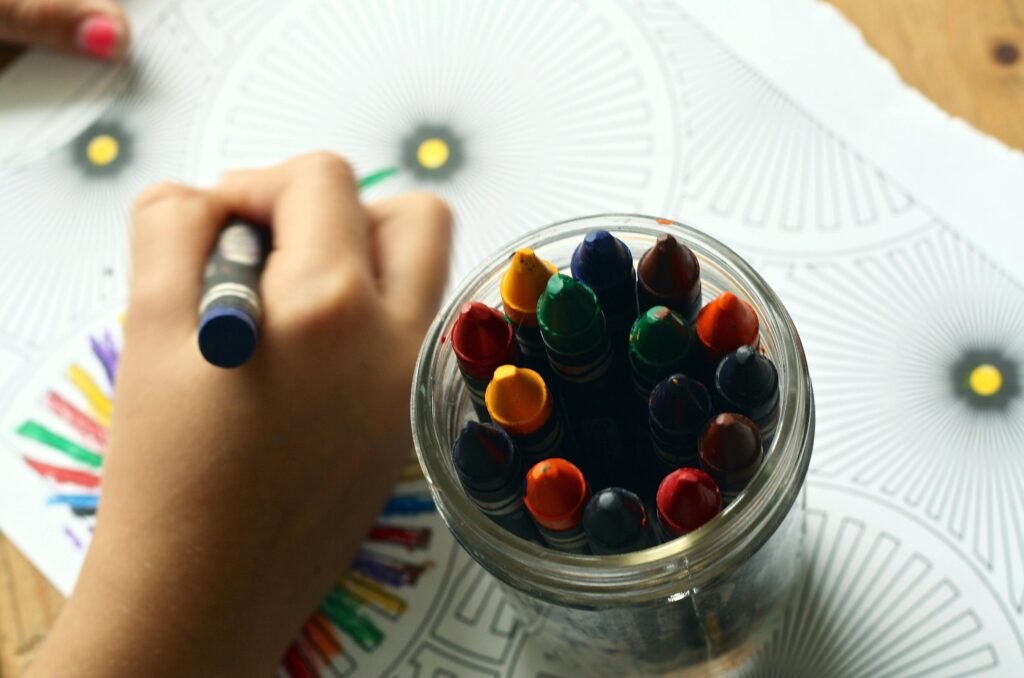
This is the simplest entry point for independent art time, and it remains one of the most effective. Coloring is accessible to nearly every age group, requires zero instruction, and naturally holds attention because the structure is already on the page.
For younger kids (ages 2 to 4), large-format coloring books with thick lines and simple shapes work best. They can grip a crayon and fill in spaces without worrying about precision. For older kids (ages 5 and up), more detailed coloring books with themes they are interested in can keep them engaged for surprisingly long stretches.
We always keep a few coloring books on hand for exactly these moments. Our go-to options have been the Coloring Adventure Coloring Books by Remington Grey. The designs are engaging without being overwhelming, which means the kids actually finish pages rather than flipping through and abandoning them. It is one of the easiest screen-free activities we have found.
For freestyle coloring, simply hand your child a blank sheet of paper and let them draw whatever they want. No prompt needed. Some kids prefer the structure of a coloring book, while others thrive with a blank canvas. Having both available lets them choose based on their mood.
Supplies needed: Coloring books or blank paper, crayons, colored pencils, or markers.
Age range: 2 and up.
2. Paper Plate Creations
Paper plates are one of the most underrated craft supplies in any household. With a single paper plate, some markers, and maybe a few scraps of paper or stickers, kids can create animals, masks, suns, flowers, clocks, faces, or whatever their imagination comes up with.
The beauty of paper plate crafts is that there are no rules. Hand your child a plate and some supplies, and let them decide what it becomes. You do not need to show them a tutorial or give them a template. A paper plate is round, sturdy, and easy to hold, which makes it a perfect base for young creators.
If your child wants more direction, you can suggest a theme. “Can you make a paper plate animal?” or “Can you turn this into a funny face?” gives them a starting point without dictating the process.
Supplies needed: Paper plates, markers, crayons, glue stick, scissors (age-appropriate), and any scraps of paper or stickers you have on hand.
Age range: 3 and up.
3. Sticker Art and Sticker Scenes
Stickers are a craft activity in disguise. For younger children, the act of peeling a sticker off a sheet and placing it on paper is a legitimate fine motor skill exercise. For older children, creating scenes, patterns, or designs with stickers becomes a creative outlet.
You can buy inexpensive sticker packs in bulk (animals, shapes, letters, stars, etc.) and pair them with blank paper or a notebook. Let your child create whatever they want. Some kids will make elaborate scenes. Others will cover every square inch of the page with stickers. Both are valid creative expressions.
Reusable sticker books are especially good for younger kids because they can peel, place, rearrange, and reuse the stickers multiple times. This extends the life of the activity significantly and makes them a smart investment.
Supplies needed: Sticker sheets or sticker books, blank paper or a notebook.
Age range: 2 and up.
4. Collage Making
Collage is one of the best independent crafts because the raw materials can be almost anything. Old magazines, junk mail, newspaper ads, wrapping paper scraps, fabric scraps, or even dried leaves from the yard can all become collage material.
Give your child a piece of paper or cardboard as their base, a glue stick, and a pile of materials to cut or tear and arrange however they like. They can create abstract designs, silly characters, dream houses, or random color arrangements. The process matters more than the product.
For younger children who are not ready for scissors, tearing paper is perfectly fine and actually helps develop hand strength. For older kids, you can introduce themes or challenges. “Make a collage of your dream vacation” or “Create a picture using only blue and green materials.”
Supplies needed: Old magazines, catalogs, junk mail, or scrap paper. Scissors (age-appropriate), a glue stick, and a base sheet of paper or cardboard.
Age range: 3 and up (tearing paper). 4 and up (with scissors).
5. Play-Doh Sculptures
Play-Doh is inherently an independent activity. Once you open the containers and set them on the table, most kids know exactly what to do. They squish, roll, shape, and create without needing any guidance.
What makes Play-Doh a craft (and not just sensory play) is when you introduce a purpose. “Can you make a pizza with toppings?” “Can you sculpt your favorite animal?” “Can you make all the letters in your name?” These prompts elevate the activity from free play to a creative project while still letting the child lead the process.
Adding simple tools like cookie cutters, a plastic knife, a rolling pin, or even a fork for creating texture gives kids more options without requiring your involvement. You can also use air-dry clay instead of Play-Doh if you want your child to create something permanent that they can paint later.
Supplies needed: Play-Doh or modeling clay. Optional: cookie cutters, a plastic rolling pin, plastic utensils for sculpting.
Age range: 2 and up.
6. Tape Resist Art
This is a simple technique that produces surprisingly impressive results, and kids can do it almost entirely on their own.
Here is how it works: your child places strips of painter’s tape (or masking tape) on a sheet of paper in any pattern they choose. Lines, shapes, zigzags, letters, random designs. Then they paint or color over the entire page, covering the tape and all the white space. Once the paint dries, they peel off the tape to reveal clean white lines underneath the color.
Kids love the reveal moment. It feels like magic, and the finished product looks way more sophisticated than the effort required. This craft works with watercolors, tempera paint, crayons, or markers, so you can use whatever you have available.
Supplies needed: Paper, painter’s tape or masking tape, paint and a brush (or crayons/markers as an alternative).
Age range: 4 and up.
7. Bookmarks and Cards
Making a handmade bookmark or card is a craft with a built-in purpose, and that purpose is what motivates kids to put in effort. When they know the bookmark is for their own chapter book, or the card is going to grandma, they naturally invest more creativity and care.
For bookmarks, cut a strip of cardstock or heavy paper (roughly 2 inches by 6 inches) and let your child decorate it however they want. Drawings, stickers, stamps, their name in bubble letters, or simple patterns all work. If you have clear packing tape, they can laminate their finished bookmark by covering it on both sides.
For cards, fold a piece of paper in half. The front is for art, the inside is for a message. Even kids who cannot write yet can draw a picture inside as their message. This craft builds literacy, creativity, and empathy all at once.
Supplies needed: Cardstock or heavy paper, scissors, markers, crayons, stickers, and optionally clear tape for laminating bookmarks.
Age range: 4 and up.
8. Dot Marker Art
If you have not tried dot markers (also called bingo daubers), they are a game changer for independent art time. They are chunky enough for toddlers to grip, do not require any brush skills, and produce bold, colorful results instantly.
Kids can use dot markers on blank paper to create patterns, fill in shapes, or just experiment with color. There are also free printable dot marker pages available online for everything from letters and numbers to animals and seasonal themes. Print a few, hand your child the markers, and they are set.
The mess factor is lower than traditional paint because the ink stays contained in the sponge tip. It does not drip, splatter, or require water. This makes dot markers one of the cleanest paint-like experiences you can offer.
Supplies needed: Dot markers and paper (blank or printed templates).
Age range: 2 and up.
9. Nature Art
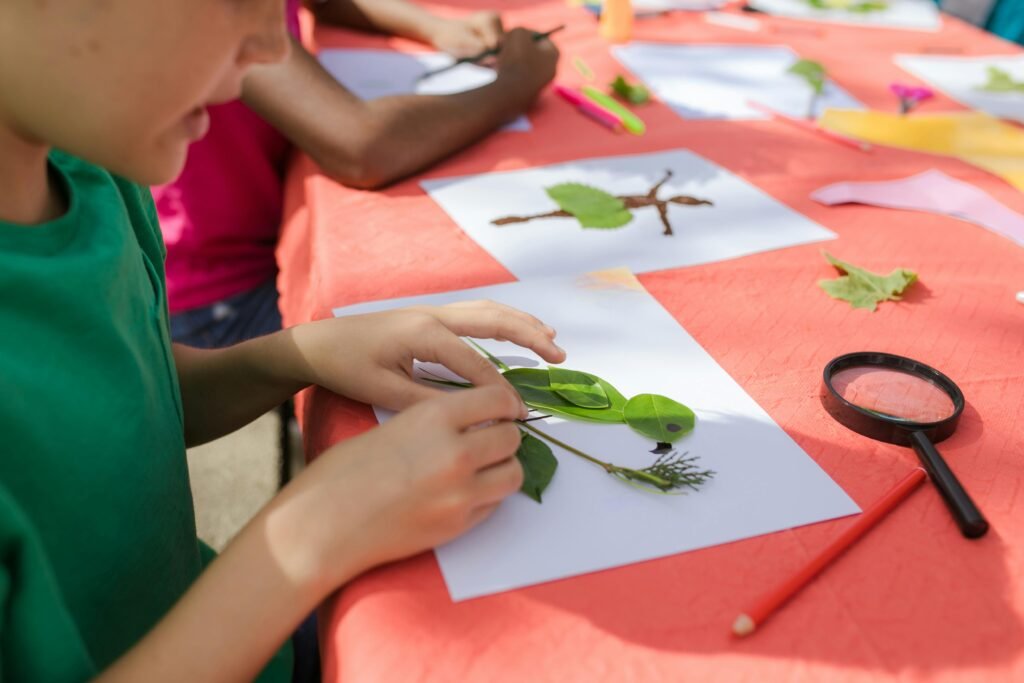
This one requires a quick trip outside first (or a few minutes in the yard), but the craft itself is entirely independent. Have your child collect natural materials like leaves, small sticks, flower petals, pebbles, or seed pods. Then bring everything inside and create art with it.
Kids can glue natural items onto paper to create pictures. A leaf becomes a tree, a pebble becomes a face, sticks become a house. They can also make patterns, mandalas, or abstract designs by arranging items on a flat surface. The combination of outdoor collection and indoor creation makes this feel like an adventure rather than just another craft.
For a simpler version, place a leaf under a piece of paper and have your child rub a crayon over it to create a leaf print. This technique works with any flat textured object and produces beautiful results with minimal effort.
Supplies needed: Natural materials (collected outside), paper, glue, and crayons for leaf rubbings.
Age range: 3 and up.
10. Recycled Material Builds
Before you toss that cereal box, toilet paper roll, egg carton, or Amazon box into the recycling bin, hand it to your child. Recycled materials are some of the best craft supplies available because they are free, plentiful, and there is zero pressure about wasting expensive materials.
Give your child a collection of recycled items along with tape, glue, and markers, and challenge them to build something. A robot, a car, a house, a spaceship, a castle. Kids approach these materials differently than traditional craft supplies because the shapes and sizes of boxes, tubes, and cartons spark ideas that flat paper cannot.
This type of open-ended building is excellent for problem-solving and spatial thinking. How do you attach a tube to a box? How do you make something stand up? How do you add wheels? These are real engineering questions that kids solve through trial and error.
Supplies needed: Recycled materials (boxes, tubes, cartons, lids, etc.), tape, glue, markers, and scissors (age-appropriate).
Age range: 4 and up.
Setting Up a Craft Station That Encourages Independence
The activities above work best when the supplies are organized and accessible. If your child has to ask you for every item, the independence factor disappears. Here are a few tips for creating a setup that lets kids craft on their own.
Use a designated bin or cart. A single bin, drawer, or rolling cart with basic supplies (paper, crayons, markers, glue sticks, tape, scissors, and stickers) gives kids everything they need in one place. They can pull it out, use what they need, and put it back.
Keep supplies at kid height. If the crayons are on a shelf they cannot reach, they will ask you to get them every time. Put the craft bin somewhere they can access independently.
Accept the mess. Crafting is inherently messy. Lay down a cheap plastic tablecloth or use a designated craft table, and let it happen. Cleanup can be part of the routine after the craft is done.
Rotate materials. Add new items to the bin occasionally. A fresh pack of stickers, a roll of washi tape, or some pipe cleaners can reignite interest in crafting without you having to plan a whole new activity.
Final Thoughts
The goal of independent arts and crafts is not to produce gallery-worthy art. It is to give your child the space, materials, and confidence to create on their own. The crooked bookmark, the lopsided paper plate animal, and the collage that is 90% glue are all signs that your child is learning, experimenting, and building skills that matter far beyond the craft table.
Keep it simple. Keep it accessible. And let them take the lead.
The best craft projects are the ones your kids actually finish. Low setup, low pressure, and high creative freedom is the formula.